Food robotics is moving beyond fixed arms that repeat one pick. Gains will come from machines that handle soft products, work safely around people, and adjust when every item looks a little different.
- Vision systems that identify shape, position, and damage before a robot acts
- Grippers that handle food without crushing, tearing, or spreading contamination
- Mobile machines that move ingredients, trays, and finished orders between work areas
Robots that can handle soft food
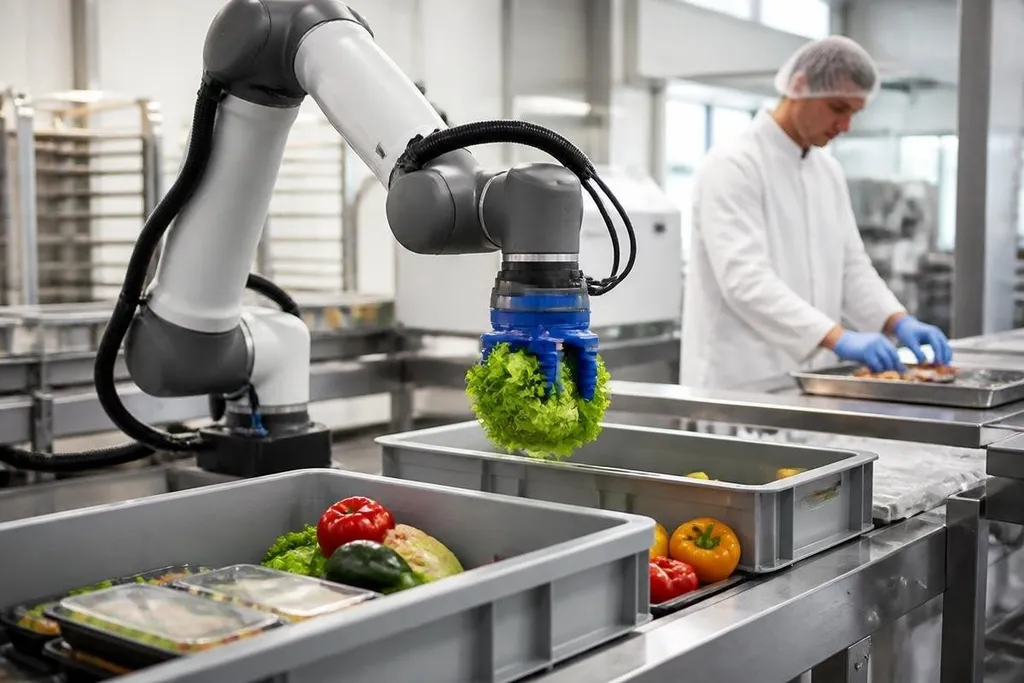
Rigid parts are easy for a robot to move. A box keeps its shape, so the arm can plan the same motion each time. Bread, fruit, meat, and prepared meals change shape when a gripper touches them.
That makes force control more important than raw arm speed. A useful system must feel resistance through its gripper, reduce pressure when needed, and place the item without dropping it. The work also calls for food-safe materials and parts that can withstand regular washing.
Better contact sensing comes next. Cameras can find an item, but they cannot tell the full story once a soft product starts to deform inside the gripper.
Combining vision with force data gives a robot more information before it moves the item to the next station.
Vision that checks more than position
Food lines need robots to see differences, not only objects. A system may need to sort by size, detect damage, find a missing part, or check whether a package is open. Each task changes what the camera and software must measure.
The useful advance will be a system that can handle normal variation without constant manual adjustment. That means better lighting control, clearer training data, and software that can flag uncertain items for a person instead of making a silent guess.
Food-robotics reports on Robot 24 can connect a machine’s stated task with its operating limits and test evidence. That leads to the next test: can it work beside people when items, lighting, or layouts change?
Automation that works beside people
Food production rarely has room for a robot that needs a large fenced area. Workers still load materials, check quality, clean equipment, and handle tasks that change during a shift. Robots must fit into that workflow without making every nearby action slow.
Safety depends on more than an emergency stop. The system needs sensors that detect people, controlled arm motion, clear restart steps, and a layout that keeps hands away from moving parts during normal work. Cleaning adds another test because water, chemicals, and food residue can affect sensors and joints.
Mobile robots could help with transport between work areas. Their value depends on reliable movement through narrow routes, clear handoff points, and batteries that last through the intended work period. A robot that moves trays but needs frequent rescue may shift the work rather than remove it.
Kitchens need flexible machines
Restaurant and food-service robots face a different problem. The menu can change, orders arrive in an uneven flow, and staff work close to the equipment. A machine built for one fixed action may struggle when the task, container, or ingredient changes.
The most useful systems will handle a defined group of tasks and make those tasks easier to repeat. Portioning, ingredient placement, cooking steps, and cleaning support all have different demands, so one machine should not be judged by a single demonstration.
I’d put flexible food handling ahead of faster motion. A robot that keeps product quality steady through normal variation has a clearer path to useful work than one that only completes a fast, carefully arranged demo.
A practical check before you buy or follow a claim
Use these questions when a food robotics project moves from a video to a possible production task:
- Name the food: Does the system handle the actual product, including its size, texture, packaging, and temperature?
- Check the handoff: Where does a person load, inspect, clean, or recover the process?
- Measure uncertainty: What happens when the camera cannot identify an item or the gripper loses contact?
- Inspect cleaning: Can staff wash the food-contact parts and reach the areas where residue collects?
- Count interruptions: How often does the system need a person to reset, refill, or clear a fault?
- Set the test: Which quality, speed, waste, and safety measures decide whether the trial continues?
These checks point to the real question behind food robotics: can the machine perform the task through ordinary variation, with a clear recovery process when conditions change? A useful breakthrough will be the one that answers that question with production evidence, not a faster video.